
A Neighborhood with Room to Breathe
Algonquin Acres occupies a distinctive corner of Centennial, just south of Cherry Creek State Park and near the broad open spaces of eastern Arapahoe County. Even as surrounding communities have filled in with newer subdivisions, shopping centers, schools, and office parks, Algonquin Acres has held on to a more spacious, rural character.
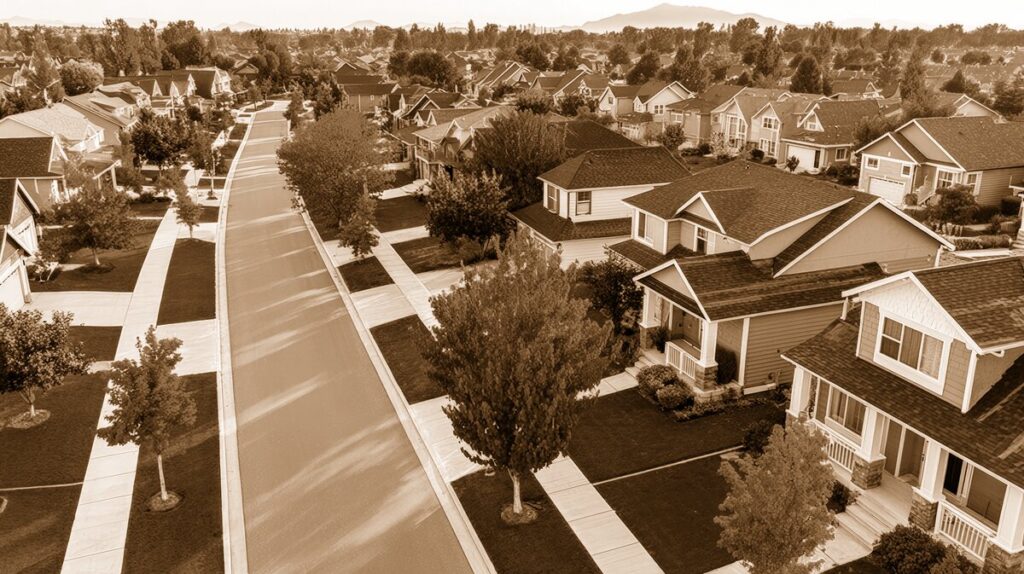
The neighborhood is known for large residential lots—many roughly three-quarters of an acre to an acre—and a varied collection of ranch homes, split-levels, two-story houses, and custom residences. Streets such as South Abilene Way, South Atchison Way, and South Billings Way are lined with mature trees, generous setbacks, and homes that often feel individually designed rather than stamped from a single builder’s plan. ([coloradohomeblog.com](https://coloradohomeblog.com/centennial-co/algonquin-acres/?utm_source=openai))
That sense of space is central to the neighborhood’s identity. Algonquin Acres feels less like a conventional suburban tract and more like a residential remnant of the countryside that once stretched across the Cherry Creek basin.
The Origins of Algonquin Acres
Algonquin Acres developed during the long transition from agricultural Arapahoe County to suburban south metro Denver. By the mid-20th century, families were moving beyond Denver and Englewood in search of larger lots, newer homes, cleaner air, and a quieter daily rhythm. The area east and south of present-day Cherry Creek State Park offered exactly that combination.
Property and housing records generally place the neighborhood’s earliest construction in the late 1950s, with additional homes and improvements continuing through the following decades. The original concept appears to have been a low-density residential subdivision: spacious lots, detached homes, and enough land for gardens, play areas, mature landscaping, and the occasional outbuilding. Later development and replacement homes continued into the early 2000s, giving the neighborhood its architectural variety. ([coloradohomeblog.com](https://coloradohomeblog.com/centennial-co/algonquin-acres/?utm_source=openai))
A basin-planning document identified Algonquin Acres as one of the established subdivisions in the Cherry Creek Basin, with approximately 80 approved lots. That is a useful reminder that the neighborhood was part of an earlier generation of semi-rural subdivisions, built before large-scale master-planned communities became the dominant pattern in eastern Centennial. ([cherrycreekbasin.org](https://www.cherrycreekbasin.org/files/eb423d60f/Evaluation-of-Phosphorus-Phase-I.pdf?utm_source=openai))
How the Neighborhood Got Its Name
The origin of “Algonquin” is not as clearly documented as the name of a city or a major regional landmark. Public records and real-estate references consistently identify the community as Algonquin Acres, but an easily accessible original naming statement from the subdivision’s developer has not surfaced.
The name was likely chosen as part of the mid-century tradition of giving residential developments a distinctive, nature-oriented identity. “Algonquin” evokes wooded landscapes, lakes, and an idealized wilderness—an appealing image for a subdivision promising open surroundings and larger homesites. The word “Acres” reinforces that promise, emphasizing land and breathing room rather than density.
In that sense, the name remains fitting. Although the farms and undeveloped parcels around it have largely disappeared, Algonquin Acres still conveys a feeling of land ownership and independence. Residents may live within the modern City of Centennial, but the neighborhood’s name preserves the memory of a time when this part of Arapahoe County felt much more rural.
Life Along the Cherry Creek Basin
The neighborhood’s setting has always been one of its greatest assets. Cherry Creek State Park, immediately to the north, provides trails, open fields, wildlife habitat, boating, camping, and the large reservoir that has become one of the region’s most important recreational destinations. For Algonquin Acres residents, the park is not simply a nearby amenity; it is part of the neighborhood’s everyday landscape.
The park also connects Algonquin Acres to the broader Cherry Creek watershed. Before suburban development, Cherry Creek and its tributaries shaped the land, supported agricultural uses, and influenced where roads and homes could be built. Today, drainage corridors and open spaces continue to affect the neighborhood’s appearance and contribute to its green, spacious atmosphere.
Nearby roads—including Arapahoe Road, Parker Road, and Broncos Parkway—have gradually transformed from rural routes into major transportation corridors. Yet Algonquin Acres remains tucked behind those busy streets. That separation helps explain why the neighborhood can feel peaceful even though it is close to shopping, employment centers, recreation facilities, and major highways.
Schools, Recreation, and Community Connections
Families in Algonquin Acres have long been connected with the Cherry Creek School District. Nearby schools have changed over the years as the district expanded, but education has remained a major part of the area’s appeal. High Plains Elementary, Campus Middle School, and Cherry Creek High School are commonly associated with the neighborhood today. ([coloradohomeblog.com](https://coloradohomeblog.com/centennial-co/algonquin-acres/?utm_source=openai))
Recreation has also evolved with the community. Trails Park and Recreation District, formed in 1983 to serve portions of unincorporated Arapahoe County, helped establish a more coordinated system of parks, trails, open spaces, and recreation facilities in the area. The district now oversees parks and trails across parts of Centennial, while other portions of the city are served by South Suburban Parks and Recreation and additional local districts. ([tprd.org](https://tprd.org/about/?utm_source=openai))
Residents can reach regional facilities such as the Family Sports Center, the Piney Creek Trail system, Dove Valley, and Cherry Creek State Park. These places add a modern recreational layer to a neighborhood whose original appeal was simply the opportunity to enjoy a larger homesite and a little more quiet.
From Unincorporated County to Centennial
One of the most important milestones in Algonquin Acres’ story was the incorporation of Centennial on September 12, 2000. Before then, the neighborhood was part of unincorporated Arapahoe County, even as nearby cities such as Englewood, Aurora, and Greenwood Village expanded around it. Centennial’s incorporation gave the area a new municipal identity while preserving the established names and character of older subdivisions such as Algonquin Acres. ([en.wikipedia.org](https://en.wikipedia.org/wiki/Centennial%2C_Colorado?utm_source=openai))
The city’s growth brought improved services, coordinated planning, road projects, and a stronger civic identity. At the same time, Algonquin Acres retained its neighborhood-scale character. It did not become a dense apartment district or a uniform new-home development. Instead, it matured gradually, with homeowners remodeling older houses, replacing outdated landscaping, and occasionally building new custom residences on existing lots.
What Makes Algonquin Acres Special Today
Today, Algonquin Acres is valued for the qualities that first attracted residents generations ago:
- Large lots and wide spacing between homes.
- Mature trees and established landscaping.
- A mix of ranch, split-level, two-story, and custom-built homes.
- Immediate access to Cherry Creek State Park and regional trails.
- Close proximity to schools, shopping, employment centers, and major roads.
- A quieter, more rural atmosphere than many newer Centennial neighborhoods.
The neighborhood has changed, certainly. Fields have become subdivisions, rural roads have become busy arterials, and older homes have been updated for new generations. Still, the essential idea behind Algonquin Acres survives: a home should have room around it, and a neighborhood should feel connected to the land.
For longtime residents, that continuity is what makes the community special. Walking along South Abilene Way or South Billings Way, one can see several decades of suburban history in a single block—original mid-century homes, carefully remodeled houses, newer custom construction, mature cottonwoods, and the open horizon beyond. Algonquin Acres is not frozen in the past. It is something more meaningful: a living neighborhood that has carried its spacious, independent spirit into modern Centennial.